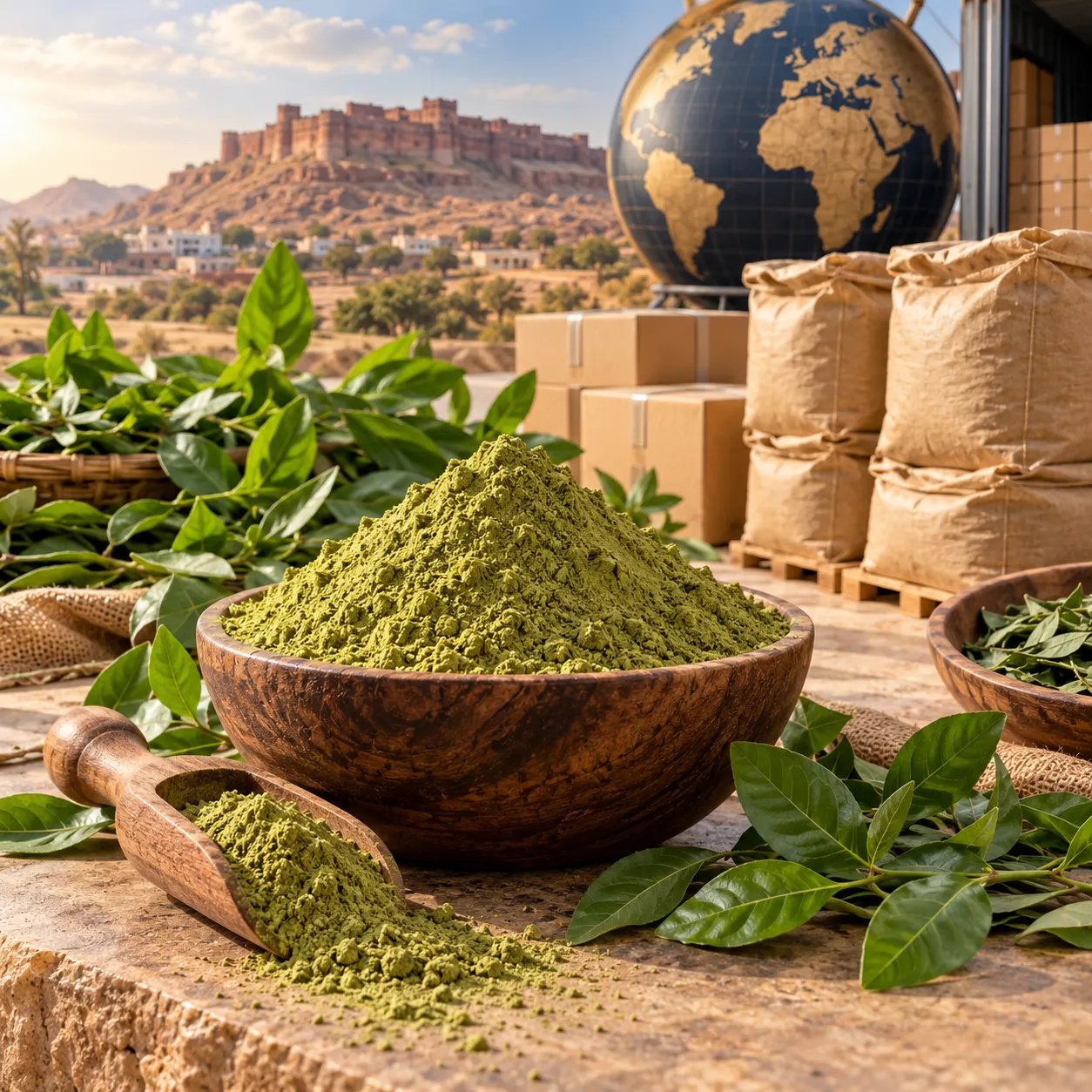
When professional mehendi artists, beauty brands, wholesalers, distributors and international buyers look for henna from India, Sojat, Rajasthan is one of the sourcing regions they frequently encounter.
That reputation is not based only on marketing. Sojat has a long-established connection with henna cultivation and trade, and Sojat Mehndi is officially registered as a Geographical Indication (GI) in India. The Government of India’s Geographical Indications Registry records Sojat Mehndi under Application No. 628 as an agricultural product from Rajasthan, with its registration certificate issued on September 14, 2021.
For international buyers, however, geographical reputation is only the starting point. Product quality, processing, filtration, freshness, packaging, documentation and reliable repeat supply remain equally important.
So what makes Sojat henna attractive to buyers beyond India? This guide explains the practical reasons.
Where Is Sojat Henna From?
Sojat is located in the Pali district of Rajasthan, India. The region has developed a strong commercial association with mehendi cultivation, processing and trade.
The National Portal of India identifies Sojat Mehndi from Pali, Rajasthan as a GI-tagged product, providing an official recognition of the product’s geographical identity.
For a business importing henna, origin matters because it gives procurement teams a clearer starting point for evaluating their supply chain. Instead of buying an unknown powder described only as “Indian henna,” buyers can investigate where the raw material was grown, how it was processed and who handled the finished product.
At Prem Henna Traders, henna is sourced from Sojat, Rajasthan, with attention to raw-material selection, processing, texture and product consistency. You can learn more about the company's sourcing approach on the About Prem Henna Traders page.
1. Sojat Has an Established Identity in the Henna Industry
One of the biggest reasons Sojat attracts buyers is specialization.
Henna is not simply another agricultural commodity associated with the area. Cultivation, leaf trading, processing, grinding, filtration and commercial supply have become closely connected with the local economy.
Rajasthan government material has also identified Pali as a key henna-producing district and Sojat as an important sourcing market for henna.
For wholesale and international buyers, sourcing from an established production region can be useful because suppliers, processors, packaging operations and related expertise are concentrated around the same product ecosystem.
That does not mean every supplier in Sojat delivers identical quality. It does mean buyers have access to a region with a mature commercial connection to henna.
2. The GI Recognition Adds Origin Credibility
Geographical Indication recognition is particularly relevant for a product strongly associated with its place of origin.
The Indian GI Registry lists Sojat Mehndi as a registered GI, while APEDA's Rajasthan GI information also records Sojat Mehndi, its Pali district location and certificate details.
For overseas buyers, this is valuable because it provides independent evidence that Sojat's connection with mehendi is more than a promotional claim.
However, buyers should understand what the GI recognition does and does not mean.
It confirms the recognized geographical identity and reputation of Sojat Mehndi. It should not be interpreted as proof that every packet sold with the word “Sojat” will automatically meet a buyer's required specification.
A professional procurement process should still evaluate individual products and suppliers.
3. Buyers Value Consistent Raw-Material Sourcing
Consistency becomes much more important when henna is being purchased commercially.
An individual customer may purchase a small pack occasionally. A distributor, salon chain, private-label company or importer may need repeat orders across months or years.
If raw-material sourcing changes constantly, finished-product characteristics may vary as well.
For this reason, professional buyers usually want clear answers about where the henna originates, how batches are handled and whether the supplier can maintain comparable specifications on repeat orders.
Prem Henna Traders states that it sources henna from Sojat and focuses on careful processing and consistent quality for professional and commercial buyers. The current Henna Powder collection includes natural, BAQ and differently filtered henna options for different applications.
4. Fine Processing Matters for Professional Mehendi Applications
Origin alone does not determine whether a henna powder is suitable for professional work.
For detailed body-art applications, powder texture and filtration matter considerably. Mehendi artists generally need a paste that can be prepared smoothly and applied through fine cone openings without unnecessary fibres or coarse particles interfering with flow.
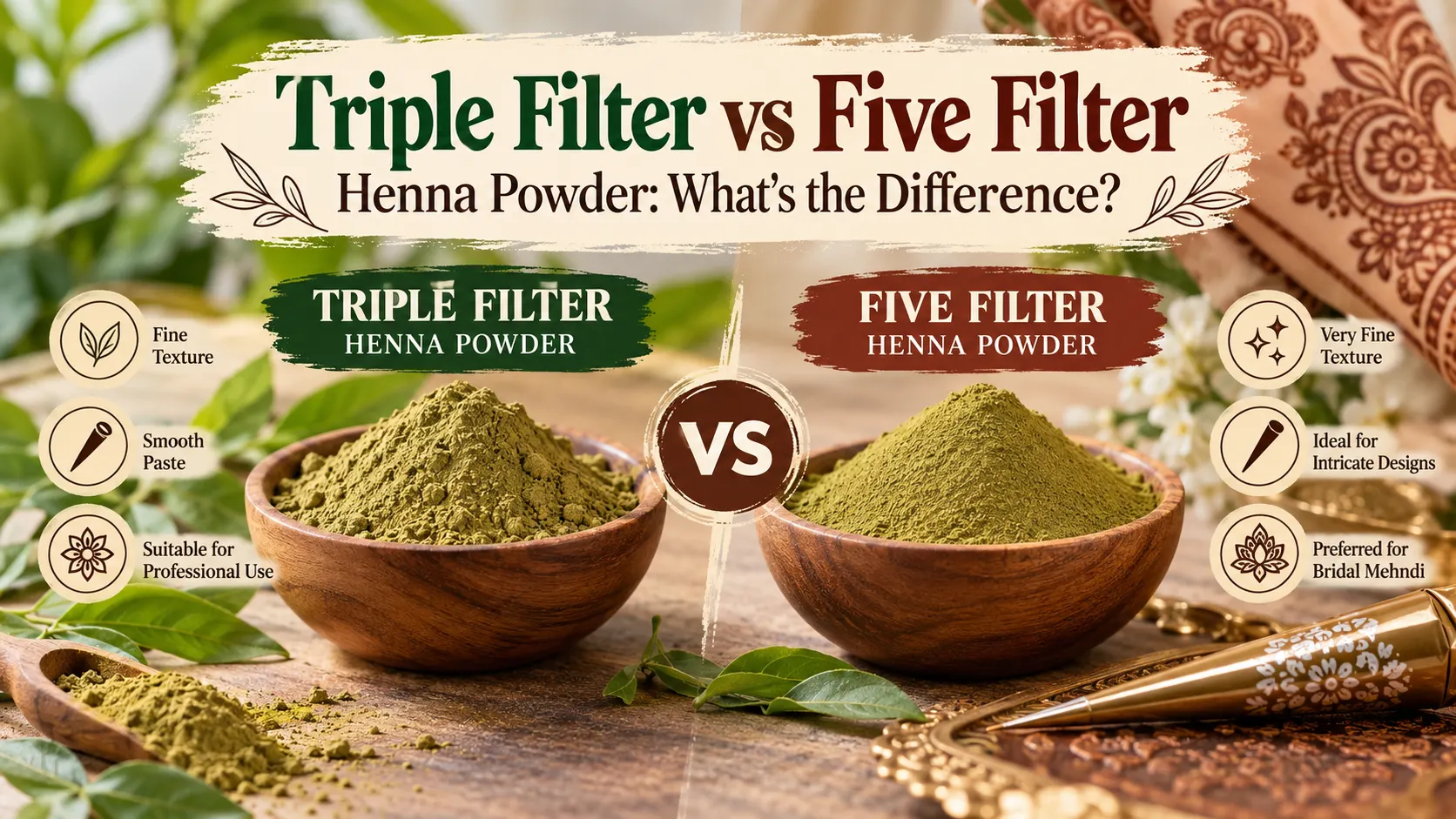
This is why buyers often encounter terms such as triple-filtered henna, five-filter henna and BAQ henna when comparing professional products.
Prem Henna's BAQ Mehandi Powder, for example, is described as triple filtered and processed to provide a microfine texture intended for mehendi and body-art applications.
For businesses deciding between different grades, the existing Prem Henna guide on triple-filter and five-filter henna can also support product selection through the site's Henna Guides and Resources section.
The important point for B2B buyers is that filtration should match the intended use. A powder purchased for detailed bridal designs may have different handling requirements from a product primarily intended for hair application.
5. Sojat Henna Supports Multiple Commercial Markets
Another reason for Sojat henna's international appeal is the diversity of markets in which natural henna is used.
Professional mehendi artists require powder for body art and bridal work. Hair-care businesses may source henna-based powders for botanical colouring products. Retailers may sell packaged henna directly to consumers, while wholesalers and distributors require larger commercial quantities.
Private-label businesses add another requirement: they need a supplier capable not only of providing the product, but also of discussing packaging formats, quantities, labeling requirements and repeat supply.
Prem Henna Traders serves several of these buyer groups and positions its range for professional, wholesale, private-label and international requirements. Buyers can explore the broader Prem Henna product range, which includes henna powders, essential oils, application tools, bridal products, aftercare items and packaging-related accessories.
6. Buyers Can Source More Than Henna Powder
For professional henna businesses, purchasing the powder is often only one part of procurement.
Artists and henna-focused retailers may also need essential oils, mixing equipment, applicator cones, filtration products, bottles, aftercare products and packaging materials.
Working with a supplier that offers complementary products can simplify sourcing, especially for businesses building a complete professional or retail henna range.
Prem Henna currently offers a separate Essential Oils collection alongside its Henna Accessories range.
For new retailers or distributors, understanding the wider product ecosystem can help determine which products should be sourced together rather than evaluating henna powder in isolation.
7. International Buyers Need More Than a Good Product
A product can perform well and still be difficult to source commercially if the supplier cannot support business requirements.
International purchasing introduces additional considerations such as commercial quantities, packaging specifications, order planning, shipping coordination and documentation.
Consequently, experienced buyers evaluate the complete supplier relationship.
Before committing to a significant order, a buyer should ideally verify the product specification, origin, filtration or grade, sample performance, packaging, available quantities, storage practices, repeat-order capability, private-label options where required, and export support.
This becomes particularly important for companies whose own reputation depends on the finished product they sell.
Prem Henna has also published a detailed guide explaining what B2B buyers should check before selecting henna products and suppliers. It covers sourcing, purity, processing, powder consistency, freshness, storage, packaging and commercial supply considerations.
8. Traceability and Transparency Build Buyer Confidence
Modern B2B buyers increasingly want more information before placing orders.
Statements such as “premium,” “best quality” or “100% pure” are not enough on their own. Serious buyers should ask practical questions.
Where was the henna sourced? What type of product is being supplied? How is it processed? What filtration grade is appropriate? Can a sample be evaluated? What packaging is available? Can specifications be maintained on repeat orders?
This approach is especially important for international buyers, distributors and private-label companies because they may subsequently make product claims to their own customers.
A transparent supplier should be prepared to discuss the actual requirement rather than simply offering the same product to every buyer.
Is Sojat Origin Alone Enough to Choose Henna?
No.
This is one of the most important points for buyers to understand.
Sojat's reputation, commercial history and GI recognition make the region highly relevant when sourcing henna from India. But geographical origin should be treated as one quality indicator—not the entire quality assessment.
Two products originating from the same region can differ because of raw-material selection, harvest conditions, processing, filtration, storage, age, packaging and handling.
For commercial purchasing, a better evaluation model is:
Origin + Product Specification + Processing + Freshness + Packaging + Supplier Reliability
This gives buyers a much stronger basis for making a procurement decision than location or price alone.
What Should Global Buyers Check Before Ordering Sojat Henna?
Before placing a substantial wholesale or import order, buyers should evaluate:
-
Origin: Confirm where the henna leaves are sourced.
-
Product grade: Determine whether the product is intended for body art, professional mehendi, hair care or another use.
-
Filtration: Ask whether the required texture and filtration level are available.
-
Sample quality: Test an appropriate sample before scaling an order.
-
Consistency: Discuss how product specifications are maintained between batches.
-
Packaging: Confirm bulk, retail or private-label packaging requirements.
-
Commercial capability: Discuss quantities, repeat supply and expected purchasing frequency.
-
Documentation and export support: Confirm the documentation required for your destination market directly with the supplier and relevant import authorities.
This type of due diligence is particularly important when the product will be resold under your own company or brand name.
Why Businesses Source Sojat Henna from Prem Henna Traders
Prem Henna Traders is based in Sojat, Rajasthan and works with natural henna products for individual, professional and commercial requirements.
Its current range includes natural henna powders, BAQ henna, multiple filtration options, essential oils and professional henna accessories. The company also states that it supports wholesale buyers, retailers, salons, private-label businesses and international customers with bulk supply and packaging solutions.
Rather than relying only on claims such as “premium” or “best,” commercial buyers should discuss their exact requirements and evaluate the relevant product before scaling an order.
Businesses interested in bulk henna, private-label requirements or international supply can contact Prem Henna Traders to discuss product type, quantity, intended application and packaging requirements.
Final Thoughts
Sojat henna's popularity among global buyers comes from a combination of factors rather than a single marketing claim.
The region has a long-established relationship with henna cultivation and trade, and Sojat Mehndi has received formal Geographical Indication recognition in India. Its established sourcing and processing ecosystem has made Sojat an important location for professional and commercial henna procurement.
For international buyers, however, the smartest approach is to look beyond origin alone.
A reliable sourcing decision should evaluate where the henna comes from, how it is processed, which grade is appropriate, how consistently it can be supplied and whether the supplier can support the buyer's packaging and commercial requirements.
That combination of recognized origin and responsible supplier evaluation is what makes Sojat particularly relevant to wholesalers, distributors, professional artists, beauty businesses and international buyers looking to build a dependable henna supply chain.
 100% Natural Henna